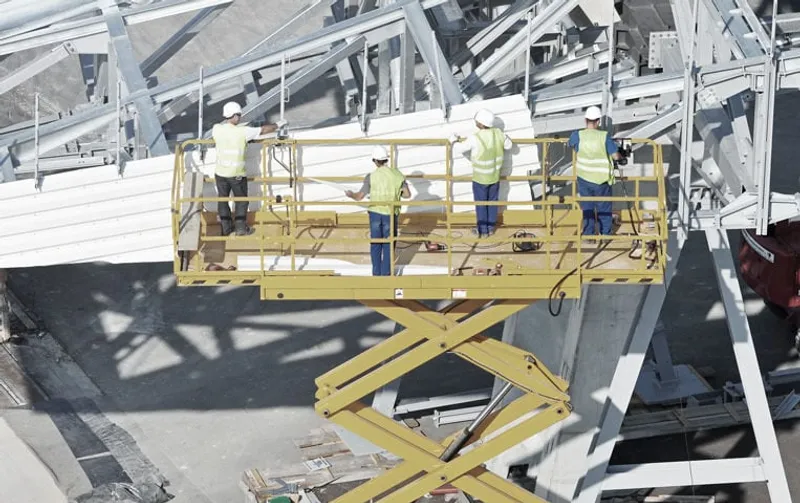
Who is Allowed to Operate a Work Platform?
One of the first questions you ask yourself is: "Am I even allowed to operate the work platform and what requirements must be met?"
The answer: Basically anyone can operate a work platform who has reached the age of 18, has received training in operating the work platform, and can demonstrate their competence to the company. Mental and physical fitness must also be considered. Additionally, an understanding of technical and physical relationships should exist, and one should act responsibly.
A distinction is made between private and commercial use of work platforms.
When renting a work platform, a private individual generally receives an induction from the rental company and is allowed to use the platform without restrictions. For commercial renters, the law requires proof of training in operation and potential hazards in written form. For insurance reasons, the training should always be documented in writing.
How Do I Protect Myself and Others When Using a Work Platform?
The most common accident causes can be summarized as follows:
- Loss of machine stability due to poor positioning
- Crushing of persons
- Ejection of persons (whip effect)
- Falls of persons when entering or exiting the raised platform
Although the client is generally responsible for safety on the construction site and the rental company is responsible for maintenance and functionality of the work platform, the operator must also pay attention to safety at all times. Above all, accidents when boarding and exiting the raised platform fall within the operator's responsibility.
For telescopic, articulated telescopic, and trailer platforms, wearing a safety harness is mandatory.
With a safety harness, workers secure themselves on the platform against ejection. Ejection from the secured platform due to the so-called "whip effect" or "catapult effect" is a frequently occurring accident and can have several causes. When passing vehicles brush against the work platform or when the platform gets caught on the building and tension builds up, this impulse can build up to the platform on telescopic platforms by design – the effect increases in strength with increasing boom height.
Unlike telescopic and trailer platforms, there is no legal regulation that requires wearing a safety harness when operating scissor work platforms.
Nevertheless, wearing a safety harness, even on scissor work platforms, may be necessary in certain cases:
- If the employer requires wearing a safety harness.
- If work is being carried out on a factory or trade show site where the site or trade show management requires wearing a safety harness.
- If the manufacturer of the work platform requires wearing a safety harness.
How Do I Find the Right Work Platform for My Project?
The selection of work platforms is large . You can distinguish them by drive type, size, weight, and of course the type of lifting technology. Each lifting platform has its purpose and justification. It is important to inform yourself in advance about the intended use and local conditions. The nature of the ground also plays an important role. If it is uneven or even has a slope, care must be taken when selecting the work platform to ensure that it can be stabilized, for example, using outriggers.
klarx Checklist for Work Platform Rental
Use the checklist to better prepare for renting your work platform. If you can check off all points and answer all questions, you are well prepared:
Site Location & Drive Type
- Electric (especially indoors)
- Diesel (for outdoor use)
- Hybrid (flexibly deployable)
Check ground conditions
- Slope / unevenness
- Hard (street, concrete, paved)
- Soft (grass, sand, gravel)
Check delivery restrictions
- Height and width of access
Check weather forecast
- Strong wind up to storm warning
- Heavy rain
- Dry and stable
Note special requirements for work platforms in advance
- Minimum working heights (At what height do you need to work)
- Lateral reach (How close can I position the work platform to the work site)
- Platform (special sizes or load capacities needed)
Depending on the requirements of your specific project, you can choose at klarx between scissor work platforms , articulated telescopic platforms , telescopic platforms , vertical mast platforms , trailer platforms , and truck-mounted work platforms . When planning your projects, pay attention to the points mentioned above from our checklist in advance to quickly and easily identify the right work platform. This way, you avoid hazards, reduce costs, and ensure smooth operation on the construction site.
How Does Work Platform Rental at klarx Work and How Long Does Delivery Take?
Our range includes all work platforms up to 40 meters. In major metropolitan areas, delivery within one day is possible. Through our logistics centers, we can significantly shorten delivery times and are on the construction site within a few hours.
From our Munich logistics center, we currently deliver the scissor work platforms COMPACT 8 and COMPACT 12 as well as the telescopic work platforms HA12 and HA15IP from Haulotte for the most diverse requirements of your project. With our partner network and logistics center, we guarantee you constant availability of work platforms throughout Germany.


