#Equipment as a Service in Construction
Equipment as a Service in Construction
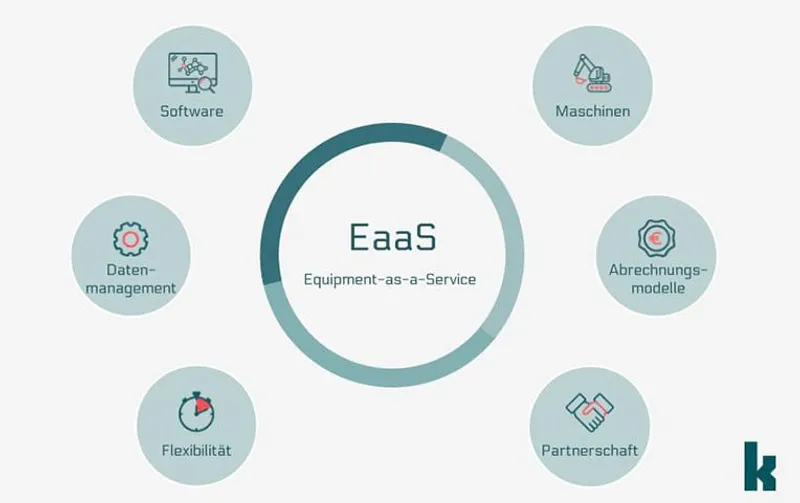
Car sharing, streaming services, software subscriptions – in many areas of everyday life, it's become normal to pay for using products rather than buying them outright. The construction industry is increasingly talking about the "Equipment as a Service" business model. We explain what it means and who benefits from this concept.
Equipment as a Service for construction machines – what is it?
Equipment as a Service (EaaS, sometimes also called Machine as a Service) means that a customer doesn't buy a machine – instead, the manufacturer or a rental company provides it as a service against a fee. The machine is located on the customer's site or construction site, but remains the property of the provider. All service work like repairs, maintenance, or replacement parts are the provider's responsibility, not the customer's: the provider ensures the machine is ready to use at all times.
Unlike a purchase, the customer doesn't pay the full cost of the machine to the provider.
Instead, the actual use of the machine by the customer matters: The machine sends data to the provider, allowing them to verify when the customer actually used it. The provider then calculates the usage fee the customer owes. Thanks to digitalization, transmitting such machine data is becoming easier and cheaper.
What's the difference between EaaS and leasing or renting?
Beyond the service work (maintenance, repairs, etc.) that the provider guarantees with EaaS, the billing method is particularly distinctive and different from leasing or traditional machine rental. Various billing models can be used:
- Subscription: The customer pays a fixed amount (for example, annually) and can use the machines at any time – as long as they don't exceed an agreed-upon number of machine hours. If they want to use the machine beyond the agreed contingent, it costs extra.
- Pay-per-Use: Here, billing is based on actual usage. The customer's actual use is recorded through machine data and transmitted to the provider. The usage fee is then calculated.
- Pay-per-Outcome: With this model, the customer pays for the results they achieve with the machine. The provider only profits if the customer succeeds – for example, by taking a percentage share of the customer's project profits.
EaaS models create a close relationship between provider and customer: the provider only gets paid when the machine is ready to use and actually used by the customer. At the same time, the provider has much better insight into the machine's operating times and can tailor their offerings to the customer's needs in the future.
Who benefits from Equipment as a Service for construction machines?
EaaS models can bring benefits to both customers and providers:
How customers benefit
- Especially with expensive machines, they don't have to invest large sums upfront. This avoids liquidity problems.
- They can flexibly respond to changing workloads through EaaS – if they don't use machines, they don't pay for them.
- They only need to handle basic maintenance and operation of the machine during the rental period.
- The provider has an interest in maintaining and preserving the machine. Both provider and customer want high machine utilization, as downtime no longer costs the customer money but mainly costs the provider. The provider bears the risk of machine downtime.
Rent construction machines or EaaS – which makes more sense for the customer?
Rental
EaaS
better machine availability, as more rental companies than EaaS providers are active on the market
more flexible billing models, such as Pay-per-Use or Pay-per-Outcome
usually cheaper when many machine hours are expected in a short period
usually cheaper when few machine hours are expected over a long period
better suited for frequently changing job sites, since local rental companies can be used and long machine transport is avoided
more flexibility when workloads change, since unused machines don't incur costs
How providers benefit
- Because EaaS models turn machines into permanent revenue sources with recurring income. Providers can build a stable business model that doesn't depend so heavily on selling individual machines.
- Because they can use the data transmitted by machines to better understand their customers' needs. They know exactly what their customers need right now and can create tailored offers.
- Because EaaS models allow them to build long-term customer relationships. Working together over a longer period creates trust between provider and customer. If the customer needs more machines, they're more likely to contact the provider they've already worked with in an EaaS model.
- Because data allows them to manage machine maintenance more efficiently. Instead of checking machines at fixed intervals, providers can perform maintenance exactly when the transmitted data shows it's necessary – data-driven decisions save providers money.
Equipment as a Service for construction machines? It currently sounds like science fiction. In reality, however, the business model is already being successfully implemented in other industries. Thanks to digitalization and increasingly easier data transmission, the construction industry will soon experience this new way of working between machine providers and customers – and both sides can benefit.
This page was automatically translated from German.