#Personal Protective Equipment on the Job Site
Personal Protective Equipment on the Job Site
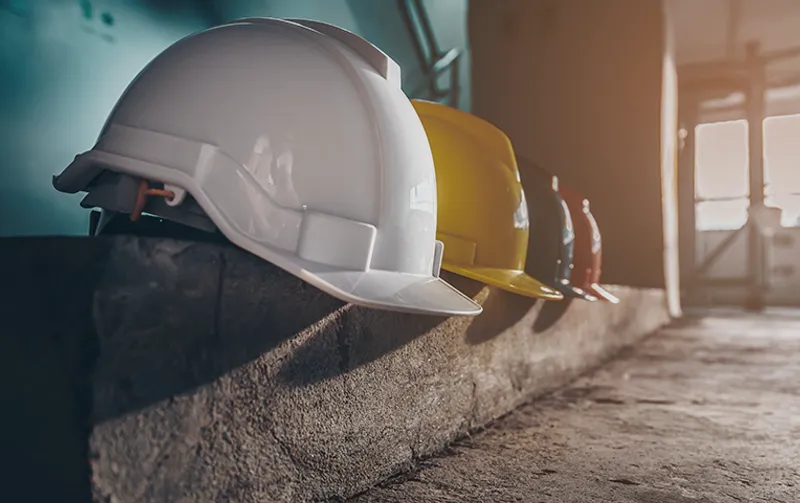
Personal protective equipment (PPE for short) is equipment that guarantees the safety and health protection of workers. On the job site, such protective equipment is essential. Learn what you need to keep in mind and which construction machines require special protection when operating them.
Job site safety with PPE
PPE is more than everyday work clothing - it's not just a uniform, but rather protects the wearer from hazards and harmful substances. This includes thermal clothing, weatherproof clothing, chemical protection clothing, machine protection suits, flame-resistant suits, and welding protection suits among the typical protective equipment.
Wearing appropriate protective clothing is also essential on the job site. Hard hats, safety shoes, and protective gloves should be available to every worker and are part of the mandatory standard equipment. Depending on which construction machines you work with and at what height the work is performed, personal protective equipment against falls (PPE-against-falls) comes into use - for example, if you rent aerial work platforms from klarx, you must always wear PPE-against-falls.
PPE and occupational safety – a requirement for employees and employers
PPE is anchored in employee protection in an EU regulation and has been adjusted and expanded many times over the years. New requirements have applied since April 2018, which give employers even greater legal certainty by involving manufacturers and retailers more in the responsibility. The obligation to wear PPE takes effect when other measures to reduce hazards and guarantee safety must be ruled out for good reasons (§ 4 ArbSchG). These measures are anchored in the Occupational Safety and Health Regulation.
According to European guidelines, a distinction is made between PPE categories 1, 2, and 3. Protective equipment used on job sites falls into category 2. The employer is required to provide the employee with proper protective clothing. It's important that the protective clothing is warm, weatherproof, and breathable depending on the season. Additionally, it should be highly visible - warning vests are essential on every job site!
Training on personal protective equipment
Employees must know exactly how to properly wear personal protective equipment. For this reason, it's legally required that employers inform their employees on a regular basis (at least once annually) about its use and provide them with important information. Specialists or safety officers can also conduct these trainings. Special training is required for PPE-against-falls, where practical exercises are also mandatory.
Renting construction equipment – What protective equipment you must wear
Fall arrest harnesses
Fall arrest harnesses should be worn when working on roofs, in construction, or when working on aerial work platforms. Pay attention to the EN361 standard, as it sets minimum requirements for fall arrest harnesses. Generally, you should wear PPE-against-falls for any work involving aerial access and check with your employer about availability.
Hard hat
A hard hat protects you from materials falling on the job site. Without a helmet, there's a life-threatening risk on job sites: tools, stones, and other objects can slip from your hand and seriously injure workers when falling from height. Hard hats to DIN EN 397 and EN 14052 are the two types used on job sites, with industrial safety helmets to DIN EN 397 being mandatory. Whether you rent a mini excavator or vibratory plates from klarx, don't forget your hard hat!
Hearing protection
Noise is a creeping health hazard that not only causes psychological stress but can also lead to deafness. Prolonged noise on job sites especially damages the ears. For this reason, it's important that every construction worker wears hearing protection above a daily noise exposure level of 80 dB(A). Wearing comfort and communication between team members are also important. When using pneumatic equipment, such as air compressors, hearing protection should be worn.
Safety glasses
To protect eyes from dust and health-hazardous liquids, construction workers should always wear safety glasses. In addition to equipment features like lens width, sun protection, size, coating, etc., the standard and corresponding protection class are two important factors when choosing your safety glasses. Further details and information on eye protection can be found on the following pages: https://www.bgbau.de/fileadmin/Medien-Objekte/Medien/DGUV-Regeln/112_192.pdf
Respiratory protection
To protect the airways from dust or even toxic substances on the job site, respiratory masks are important. Especially when cutting building materials, particles can enter the airways and become a hazard. Typically, respiratory masks are divided into three categories that, depending on filter strength, filter particles completely or partially. Further information can be found in the DGUV Rule 112-190.
Gloves
Hand injuries happen quickly on job sites - so it's important to wear proper protective gloves. For mechanical risks and assembly work, cut-resistant gloves are recommended, and they should display a hammer symbol, which guarantees protection against impacts. A four-digit numerical combination indicates how abrasion-resistant, cut-resistant, tear-resistant, and puncture-resistant the glove is - the higher the number, the better protection the glove offers in that particular area.
Safety shoes
Robust shoes with steel caps should always be worn on the job site. Steel caps protect against heavy materials falling on your feet. Slip resistance and traction on slippery surfaces are two additional features that make safety shoes an important part of PPE. This allows safe working even at great heights. You can identify the right safety shoes according to the EN ISO 20345 standard.
klarx explicitly points out that wearing appropriate PPE is absolutely necessary and must be monitored by the employer. Only this way can injuries and hazards on the job site be avoided.
This page was automatically translated from German.