
In conversation with Christopher Geng, Managing Director of Markstahler Rohrleitungsbau
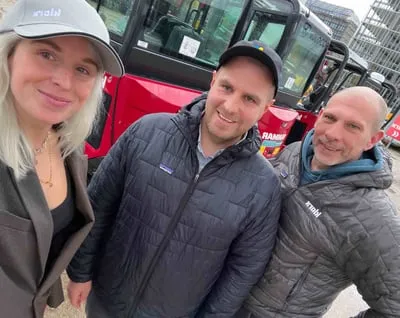
klarx met with one of our customers – Christopher Geng, Managing Director at Markstahler Rohrleitungsbau. In the interview, we asked how sustainable utility line construction really is and how much influence it actually has on the energy transition.
What does Markstahler Rohrleitungsbau actually do?
Until early 2022, we were primarily responsible for expanding natural gas pipelines. The war situation and the ongoing energy transition led us to optimize and adapt our business model.
Our core business remains pipeline construction, especially water and gas pipeline construction. The electricity share has become enormously larger, and so we work for major energy suppliers. District heating is increasingly coming into focus.
How do you typically proceed with construction projects until completion?
It depends entirely on the project. As a rule, we work with annual contracts and services are clearly defined. With project work, it's about calls for tenders from, for example, municipalities. Once everything is arranged, planning and construction begin. From the planning stage onwards, you – klarx – come into play to provide us with the construction equipment we need, such as lift platforms, excavators, or dumpers. The good thing is that thanks to you, we can also rent equipment on short notice if something shifts or we face bottlenecks internally.
You mentioned that you had to adapt your business model.
What challenges do you see in implementing the energy transition in the construction industry, and how do you address them?
An important topic is CO2 accounting, which we'll already be tackling this year. I can imagine that a company can gain an advantage in tenders if it knows its own values.
Sustainable work is increasingly coming into focus. Last year, we replaced all our power generators with power banks. Since we work at specific locations, we don't need large generators on the job site. These are not only loud but also consume a lot of energy. We also use electric vehicles when traveling to job sites.
As a business owner, I naturally have to ask myself every day how we can best handle the issue of sustainability.
How do you personally approach the topic of "sustainability"?
When we dig a trench, we try to coordinate as many projects as possible and ask municipalities if there are other measures we can include. We always try to think ahead and have an influence on areas in the value chain where we can. This ultimately saves time and energy.
To what extent do EU measures influence your decision when renting construction equipment?
We initially didn't always pay attention to how sustainable renting construction equipment can really be and how to define it. You certainly focus greatly on maximum transport kilometers* and operating time of construction equipment on the job site. When we have the option to decide whether to rent an electric version or diesel, we choose the former – as long as the performance is adequate, of course.
Now let's get down to brass tacks: How do you see the future?
What challenges do Markstahler Rohrleitungsbau and the construction industry face in 10 years?
The switch to alternative propulsion systems will definitely cost money and be time-consuming. There's a shortage of skilled workers, especially in the trades. We also need to have enough resources for alternatives. The best example is biogas, which we offer. However, there isn't enough of it, so demand is met right up to the limit until nothing is left. This raises the question of whether this approach itself is sustainable. Even if the energy generated from it is sustainable, it falls short in other areas. There's also a lack of hydrogen. While natural gas can and should be replaced by hydrogen by 2035, if there isn't enough of it, it doesn't help anyone. Currently too much is lost in hydrogen production for it to be profitable.
Okay, that sounds like a paradox. Who are the winners in all this?
Electricity suppliers will have all the trumps in the future. Ultimately, everything can be converted to electricity – gas, solar energy, wind energy – it all comes down to electricity. There's currently a lot of momentum in network expansion, and many operators are realizing that cable cross-sections are too small when heat pumps or e-mobility are added. In some cases, entire solar farms can't connect to the grid because the grid can't handle the required voltage at certain points.
I have one more question, regarding building renovation requirements: Are you already feeling the effects of the EU decision?
Currently it's manageable. We notice it when it comes to the rapid replacement of heating systems under the GEG (Building Energy Act). But general builders are running out of contracts. This means that in the future, we'll need to focus less on new construction and more on renovation.
Summary: What We Learned About Utility Line Builders and Their Challenges
Much of it seems more like an ad-hoc government announcement that could change at any time. This also raises the question of sustainability: How sustainable can a statement itself be if the necessary conditions don't yet exist?
That's why it's all the more important to reliably plan the things that are within your control. klarx as a solution provider for renting construction equipment and facilities ensures guaranteed availability of construction machines and provides comprehensive service. This allows utility line builders to act sustainably from the planning phase onwards and meet their construction equipment needs. Reliability means providing resource-saving measures so construction projects can be successfully realized. And that's what klarx does.


