#Aerial Work Platforms – Do I Need a Driver's License?
Aerial Work Platforms – Do I Need a Driver's License?
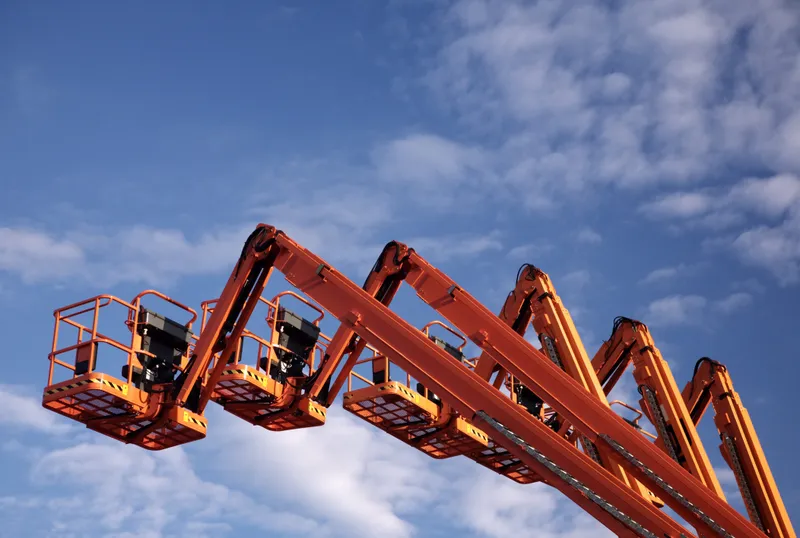
Do you need an aerial work platform license? We explain everything about legal requirements, age restrictions, and operator certifications.
Is an Aerial Work Platform License Required?
In Germany, there is no aerial work platform license required for all individuals. This means that as a private person, you can operate an aerial work platform without a license. When you rent an aerial work platform, the rental company will provide instruction on how to operate the equipment safely.
However, there are some rules to follow for commercial use. You must provide proof of participation in a safety briefing. This is the closest thing to what you might call an "aerial work platform license." Before using any work equipment, employees must be informed about potential hazards – this applies to rented equipment as well. This process is called a "safety briefing" and is legally mandatory. To operate an aerial work platform for commercial purposes, no license is required – but a safety briefing is mandatory.
The employer is responsible for the safety briefing, as they are best positioned to assess the potential hazards of the planned work. There are no formal requirements for how the briefing must be conducted, but it must be documented. Additionally, the worker must be given written authorization to use the aerial work platform. For private use, no safety briefing is necessary.
Do I need an excavator license?
Who Can Operate an Aerial Work Platform?
An aerial work platform can be operated by anyone who has reached 18 years of age, has been trained in operating the equipment, and can demonstrate their competence to their employer. Mental, character, and physical fitness must also be considered. In particular, visual acuity, peripheral vision, spatial awareness, hearing, physical mobility, and good reaction time are important. Additionally, an understanding of technical and physical principles is important, and the operator must act responsibly.
When Is an Operator Certificate Required? And How Much Does It Cost?
Although specific training, which can be proven with an operator certificate, is not legally required, the DGUV Guideline 308-008 still recommends undergoing such training. The training consists of theoretical and practical components. Each part concludes with a final exam, during which a specified number of errors cannot be exceeded. Training typically lasts at least one day, and upon passing the exam, participants receive a training certificate. The cost of such a certificate varies depending on the provider, but is typically between €150 and €300.
Training in accordance with DGUV Guideline 308-008 can be completed with providers such as Dekra (https://www.dekra-akademie.de/de/hebebuehnen-fuehrerschein/), IPAF (https://www.ipaf.org/de/ipaf-schulung), alpintec (https://www.alpintec.de/ausbildungtraining/sonstige-kurse/unterweisung-zum-fuehren-von-hubarbeitsbuehnen-nach-dguv-g-308-008/), and many dealers and rental companies organized in the bbi trade association.
The operator certificate can also serve as proof of proper safety training, which is legally required for commercial use. Even though formal training is not legally mandatory, there are good reasons to complete it. This allows workers to operate aerial work platforms more safely and with reduced accident risk.
Who Can Drive an Aerial Work Platform?
If you drive a truck-mounted aerial work platform on public roads, you must have a valid driver's license. For smaller models weighing up to 3.5 tons, a standard Class B car driver's license is sufficient. If the equipment weighs more than 3.5 tons, a truck driver's license of the appropriate class is required (up to 7.5 tons: Class C1, and over 7.5 tons: Class C).
Here's a quick summary of the key points for operating aerial work platforms:
- For private use, anyone can operate an aerial work platform without a license
- When renting, the rental company will provide instruction
- For commercial use, a safety briefing is mandatory
- The operator must be at least 18 years old and must demonstrate competence
- An operator certificate can serve as proof of competence, but is not legally required
- On public roads, a valid driver's license is required depending on the weight of the equipment
This page was automatically translated from German.